How Can a Foreign Investor Maximize Available Tax Incentives in Jordan?
This is where many articles about foreign investment become misleading.
There is no universal “100% tax exemption” simply because a company is foreign-owned.
Instead, Jordan’s investment framework provides different incentives depending on factors such as:
- The nature of the investment.
- The economic activity.
- The location of the project.
- Whether the project is located in a development zone.
- Employment of Jordanian workers.
- Export activity.
- Technology and knowledge transfer.
- Economic impact.
- Investment size.
- Other statutory conditions.
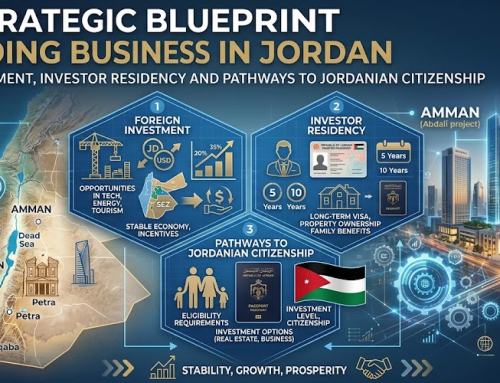
The Ministry of Investment describes Jordan’s incentive framework as including customs exemptions, zero-rated sales tax on qualifying production inputs, income-tax incentives and additional incentives depending on investment size and location.
The key is eligibility—not simply ownership.
Development Zones: Where the Tax Structure Can Become Particularly Attractive
For investors whose business model fits within a Jordanian development zone, the tax and customs framework can be particularly significant.
Under the Investment Environment Law, qualifying registered enterprises in development zones may benefit from specific tax treatment, including zero-rating of general sales tax on qualifying goods and services purchased or imported for conducting economic activity within the zone.
The Ministry of Investment also states that qualifying projects in development zones can benefit from:
- Income-tax reductions.
- Customs exemptions.
- Zero sales tax treatment on qualifying fixed assets and production inputs.
- Additional incentives in less-developed areas.
Some incentives can extend beyond the standard period where the project is located in qualifying less-developed areas.
Two companies conducting similar activities can have different incentive outcomes depending on where the investment is established.
Therefore, before signing a lease or purchasing property, an investor should ask:
“Would establishing this operation in a designated development zone materially improve my overfall tax and operating position?
That calculation should be performed before the location is finalized.
Can Industrial Investors Obtain Customs and Sales Tax Benefits?
Potentially.
Jordan provides specific incentives for qualifying industrial projects. According to the Ministry of Investment, industrial projects may benefit from exemptions from customs duties on qualifying fixed assets, production requirements, inputs and spare parts, together with a 0% sales-tax rate on qualifying acquisitions and inputs. Income-tax reductions may also be available for qualifying projects, depending on factors including employment and location.
For a manufacturer importing significant quantities of:
- Production lines.
- Raw materials.
- Spare parts.
This is why incentive planning should take place before purchasing equipment or importing production inputs.
Can Foreign Investors Transfer Their Profits Out of Jordan?
Yes, subject to applicable legal and tax requirements. The Ministry of Investment states that foreign companies may transfer profits abroad after complying with applicable tax obligations. The investment framework also provides for the transfer of convertible currencies into and out of Jordan. For multinational groups, however, profit repatriation should be planned together with: Corporate taxation. Dividend distributions. Withholding-tax considerations. Intercompany arrangements. Banking requirements. Accounting records. Regulatory compliance. The ability to repatriate profits should therefore be incorporated into the company’s structure from the beginning.
What About Hiring Foreign Employees?
A foreign-owned company may need international executives, technical specialists or regional management.
Jordan’s investment framework allows foreign investors to employ non-Jordanian workers subject to applicable rules and conditions. The Ministry of Investment states that foreign investors can employ up to 40% non-Jordanian workers in administrative and technical positions, subject to the applicable framework.
Employment planning should therefore cover both:
Jordanian employees
- Employment contracts.
- Social Security.
- Statutory benefits.
- Working conditions.
- Termination requirements.
Foreign employees
- Work permits.
- Residency requirements.
- Position classification.
- Applicable quotas or conditions.
- Employment compliance.
For an international company, these requirements should be reviewed before relocating employees to Jordan.
What Foreign Investors Often Get Wrong
Mistake 1: Assuming 100% Foreign Ownership Means No Restrictions
It does not. Ownership rules depend on the activity.
Mistake 2: Choosing the Company Structure First
The structure should follow the investment strategy. Not the other way around.
Mistake 3: Incorporating Before Checking Incentives
You may miss opportunities to structure the investment around available incentives.
Mistake 4: Assuming Every Tax Incentive Applies Automatically
Most incentives depend on statutory conditions and eligibility.
Mistake 5: Choosing the Location Without Reviewing Incentives
For qualifying projects, location can materially affect the available investment incentives.
Mistake 6: Treating Incorporation as the End of the Process
Licensing, tax, employment, Social Security and regulatory compliance continue after registration.
Mistake 7: Using a Generic International Corporate Structure
A structure designed for another jurisdiction may not be optimal under Jordanian law.
The 2026 Investment Environment: Why Current Legal Advice Matters
Jordan’s investment framework continues to evolve.
In June 2026, the amended Investment Environment Regulation was officially published in the Official Gazette. The amendments introduced reforms intended to improve competitiveness, streamline regulatory procedures and enhance Jordan’s investment environment. Among the changes was a new concept concerning a license to conduct economic activities subject to compliance within development zones.
For investors considering Jordan today, this matters. An article written several years ago may accurately describe the general investment framework while failing to reflect current procedures and incentives.
Foreign investment advice should therefore be based on the legislation and regulations applicable at the time your investment is structured.
Your 100% Foreign-Owned Company: A Better Investment Strategy
The objective should not simply be: “How quickly can I register my company?”
A sophisticated investor should instead ask: “How can I structure my Jordanian operation so that I retain full ownership, obtain the necessary licenses, qualify for the incentives available to my project, minimize unnecessary tax exposure, and protect my investment over the long term?”
That requires coordination between:
- Corporate law.
- Foreign investment regulations.
- Real estate.
- Commercial contracts.
- Intellectual property.
This is where local legal counsel becomes a strategic investment adviser rather than simply a company-registration services provider.
Why Work With a Jordanian Corporate Law Firm Before Investing?
For an international investor, the value of Jordanian counsel is not limited to completing government forms. Experienced local counsel can help you answer the questions that determine the economics and legal security of your investment:
Can I own 100%?
Which legal structure should I use?
Which licenses will I need?
Which development zone or location is appropriate?
Which tax and customs incentives may apply?
What conditions must I satisfy to preserve those incentives?
Can I employ foreign executives?
How can I repatriate profits?
How should my contracts be structured?
How can I protect my investment if the commercial relationship breaks down?
These questions should be answered before capital is committed.
Establish Your Jordan Company With the Right Structure From Day One
Jordan can provide an attractive platform for foreign-owned businesses, but the benefits of the investment framework are not automatic.
The strongest approach is to design the investment around the investor’s objectives from the beginning.
At Al Noubani for Law, we advise foreign investors, multinational companies and international entrepreneurs entering or expanding in Jordan.
Our Jordan market-entry support can include:
- 100% foreign ownership assessment
- Jordan company formation
- LLC and foreign-company structuring
- Foreign investment regulatory analysis
- Investment incentive and development-zone assessment
- Tax and customs incentive coordination
- Commercial licensing
- Employment and expatriate workforce compliance
- Commercial contracts Corporate governance
- Regulatory compliance
- Dispute resolution and representation
Planning to Establish a Foreign-Owned Company in Jordan?
Before incorporating, signing a lease, acquiring assets or transferring investment capital, obtain a legal assessment of your proposed structure and eligibility for available investment incentives.
Contact RN Law for a confidential consultation on establishing and structuring your 100% foreign-owned business in Jordan.
Your objective should not be simply to establish a company.
It should be to establish the right company, in the right structure, in the right location, with the right regulatory and investment strategy from day one.
Frequently Asked Questions About Foreign Company Formation in Jordan
Can a foreigner own 100% of a Jordanian company?
Yes, in most sectors. Certain regulated activities remain subject to specific foreign ownership restrictions or conditions.
Is there a minimum capital requirement for a foreign investment project?
The Ministry of Investment states that, under the Investment Environment Law No. 21 of 2022 and Regulation No. 7 of 2023, there is no general minimum capital requirement for registering a foreign investment project. Specific activities or structures may nevertheless have their own requirements.
Does a foreign investor need a Jordanian partner?
Not generally. Except in specified restricted sectors, foreign investors may establish businesses with 100% ownership.
Can I establish my Jordanian company while living abroad?
Yes. The Ministry of Investment states that a foreign investor residing outside Jordan may authorize an agent in Jordan through a power of attorney to complete establishment procedures.
Can I transfer my profits outside Jordan?
Foreign companies may transfer profits abroad after complying with applicable tax obligations.
Does Jordan offer tax exemptions to foreign investors?
Jordan provides a range of tax, customs and other investment incentives, but eligibility depends on the investment, activity, location and applicable statutory conditions. There is no blanket tax exemption solely because a company is foreign-owned.
Is a development zone worth considering?
Potentially. Qualifying businesses operating in development zones may benefit from specific income-tax, customs and sales-tax incentives. The suitability of a development zone should be assessed against the company’s actual business model and operational requirements.
This article is for general informational purposes only and does not constitute legal or tax advice. Investment ownership rules, licensing requirements, tax treatment and investment incentives depend on the specific activity, structure, location and circumstances of the investor and may change as Jordanian legislation and regulations develop. A transaction-specific legal and tax assessment should be obtained before establishing or funding an investment in Jordan.